
Wild Encounters With Nature’s Ecosystem Engineers

A Moonlit Introduction to Beavers
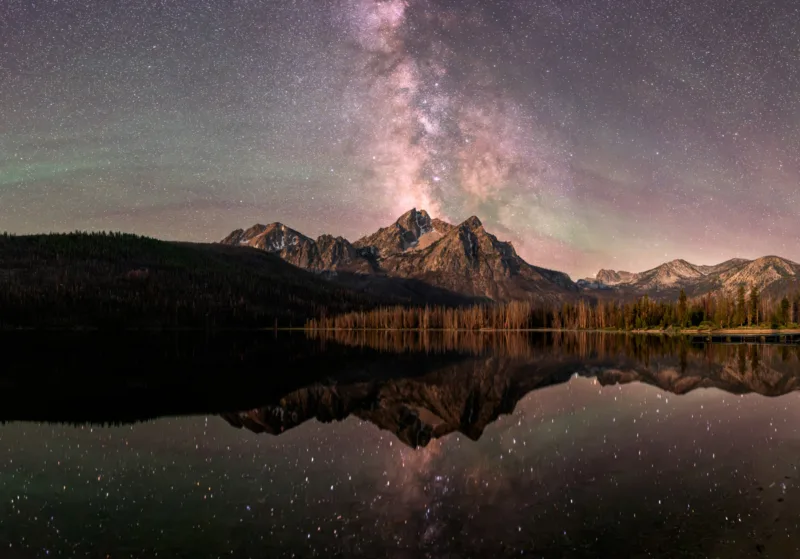
Darkness surrounding me in central Colorado. The Milky Way reflecting in a still pond. Stars blazing overhead. I’m waiting for a long exposure to finish on my camera. CRACK!! A tail slap explodes across the water. Every. Single. Time. I swear I am one day going to lose a camera to the beavers.
That’s what I get for intruding. And really, who can blame them? It’s not every night you have a large mammal invading your privacy. Beavers slap their tails on the water as an alarm signal, warning the rest of the colony that something in the area isn’t right. In my case, usually me and a tripod.
I’ve spent many quiet, reflective hours photographing beavers over the past few years, and they never cease to amaze me. Beavers are North America’s largest rodent, true ecosystem engineers, and yet most people walk right past their habitats unknowingly.
In This Post
Meeting the Beavers
My first encounter happened a couple of years ago in a canyon not far from Denver. I’d spent the day scanning cliffs for bighorn sheep, and on my hike out, another hiker mentioned spotting a beaver taking down young willows near the river. Beavers are primarily nocturnal, so a daytime sighting immediately sparked my interest. I hiked about a mile down the trail and settled in to wait.

Patience is crucial to wildlife photography. Whether you’re waiting for an animal to accept your presence or sitting quietly beside a random hole hoping something emerges, more often than not it’s a bust. This afternoon, however, my patience paid off.

A chunky beaver came waddling down the riverbank carrying a small stick. It was my first wild beaver, and I took full advantage. Gripping his stick with his orange teeth, he was hard at work. The iron in their enamel stains them orange and makes their incisors stronger than ordinary teeth.
Determination
Over the next half hour, I watched it haul the stick upstream and over a rock spillway, depositing it in its underwater pantry before immediately returning to the willows for more. Back to waiting. Sitting there watching the willows moving on the opposite bank but not seeing the beaver was pure torture.

Just as I was about to pack up and beat Denver traffic, it popped out of the willows again, but this time with a real stick.

The next hour was spent admiring this determined beaver as it struggled upstream with a small tree in its mouth, refusing to give up even over the rocks. One paw at a time, it dragged the tree up and over the boulders, stopping every few feet to readjust the branch with its front paws before trucking on.


This series of images has stuck with me over the years. It felt like a quiet lesson in persistence in a world often drawn to the easiest path. The same kind of quiet lesson I took home later from watching sandhill cranes endure a winter storm in New Mexico.
Beaver Ponds and Mountain Scouting
A few years later, I found myself in central Colorado scouting workshop locations with my partner Brad Goldpaint. Early May in the mountains brings warm days, cool nights, and the first spring flowers just opening. Beaver ponds are everywhere up there, and where there are beavers there are also moose and bears. All things worth keeping in mind when you’re planning to shoot in the dark.

We had spent several long days exploring backroads and getting familiar with the area before settling in one evening at camp. After a day spent editing images and mapping out a game plan, we decided to take a break and check out the large beaver pond just below our campsite. As luck would have it, I spotted a V-shaped wake moving through the water, a branch riding along with it. I unintentionally SMACKED Brad with the foam pad I had been carrying and bolted for my camera while he set up and watched where the beaver went.
Watching & Waiting

The beaver stayed at a distance, swimming back and forth with willow branches. Watching it work, we realized there was more than one. Every time we thought we had them pinned down, they would pop up in a different channel.

It was like playing whack-a-mole, but with beavers. Since beavers can hold their breath for up to 15 minutes and swim underwater for half a mile, these long silences between sightings were them doing what they do best.

One eventually surfaced about 100 feet away on the opposite bank, close enough for a few shots but nothing to write home about. Just as we thought that was as good as it was going to get, one popped up about 20 feet in front of us. It proceeded to munch on willows before swimming back to its lodge. As the sun set, the bone-chilling wind sent us looking for hot soup before calling it a day.

A Beaver Colony in Grand Teton National Park
My favorite encounter to date happened in Grand Teton National Park. I have always known that the Greater Yellowstone ecosystem is extraordinary for wildlife, but nothing quite prepared me for the bustling beaver colony, typically a breeding pair, their yearlings, and the newest kits, all sharing one lodge that surprisingly was comfortable with our presence.

While scouting locations for our Grand Tetons at night workshop, I stumbled across a thick aspen tree that had recently been brought down by a beaver. The telltale cone shape and chew marks from their ever-growing teeth are unmistakable. Not having a lot of spare time, but now having that itch to investigate, I poked around for a few minutes and found one of the water channels they use for moving trees. Following the channel brought me to a large solid dam creating the perfect pond.
Always Bring Your Camera!
Things were looking promising, aside from it being early afternoon, never a good time for wildlife, especially nocturnal ones. The silence around the pond was broken only by the buzzing of mosquitoes and the occasional voice of a nearby tourist checking out a short trail. As I stood there scanning the water, a juvenile beaver, or what biologists call a kit in its first year, calmly swimming straight toward me.
I was ecstatic, and of course, as any good photographer would do, I had left my cameras back in the car. It was early afternoon. Terrible light. New location. Scouting time. Clock ticking. No need for cameras. Wrong.

After alerting Brad to their presence, I bolted to the car. By the time I got back the beaver had moved on, but not before having lunch about ten feet in front of Brad, who whipped out his phone and got a video. I still haven’t heard the end of that one.
That afternoon went way too quick. Returning with my cameras, I managed a couple of images before the little beaver swam back upstream. Brad had to remind me that we were on the clock and had work to do.

I returned two days later in hopes of getting lucky a second time. Nothing, not even a ripple. Discouraged, I called it when it started raining, telling myself I still had a few days left and that I’d check in again before we left.
Two days later, we did just that.
Mosquito Heaven
We sat there feeding the mosquitoes for an hour and a half. Nothing. This is wildlife photography. There are no guarantees. Understanding animal behavior and knowing where to look makes all the difference, but sometimes it comes down to pure luck. With no sign of life other than the blood-sucking mosquitoes enjoying every drop they could get, we sat there debating whether to call it and stop feeding the locals or give it a little more time. Just as we started to stand up, here came a beaver swimming straight at us. We stayed low and chuckled. I guess the locals weren’t done with us yet.

A Photographer’s Dream
Not a single warning tail slap. That signature loud CRACK on the water that beavers use to alert the colony to danger. It felt like a rare privilege, being quietly accepted into their world. Switching between images and video (had to out-do Brad), we sat and watched for nearly three hours while multiple beavers came by feeding, grooming, and casting the occasional glance our way. As the sun set, and our stomachs reminding us that we hadn’t packed a lunch, we left reluctantly, already planning to return during next year’s workshop.

Bath time at the pond. Between feeding sessions, beavers spend serious time on grooming; keeping their dense fur clean and waterproofed is a full-time job when your home is half underwater.
Whether it’s wildlife or shooting the night skies, the moment you decide to pack up is the exact moment everything happens. Animals finally become comfortable with your presence or decide to move into the right light. The clouds that weren’t supposed to be there finally cleared, and the light is just perfect.

Photographing Beavers by Moonlight
Fast forward two months and we’re back in Colorado for our Fall Colors at Night workshop. Our clients are photographing a beautiful fall scene, a small river in front of a dramatic mountain backdrop. CRACK!!

The locals weren’t happy. It was a faint crack, but beaver ponds surrounded us and willows were everywhere. Unable to pinpoint exactly where they were, we did our best to give them space while keeping a wary eye out for moose, who frequent the area.

After the workshop wrapped, we went back to capture the fall colors. It didn’t take long before we heard it again, this time right in front of us. The late afternoon light gave us time to let them settle and resume their dinner while keeping a close eye on us. We got back to photographing the beavers, of course. The sunset we had hoped for was dull as could be.

The Challenge
Once it got dark, we returned to the task at hand: fall colors, stars, and moonlight. A couple of hours later, we heard another crack. I laughed and said, “Well, why not? I’m pretty sure no one has ever photographed beavers by moonlight before!” Brad laughed and wished me luck. “‘Cuz there ain’t no way that’s going to work.”
Challenge accepted. They won’t win any competitions, but I did it. I photographed not one but two beavers in the dark with moonlight. Sometimes the small victories are the best ones.

“If you ever find yourself near a beaver pond at dusk, slow down. Give it an hour. I am sure you will understand why I keep going back. And if you are photographing at night near a beaver pond, hold on to your cameras. You never know when… CRACK… SPLASH!!”
— Evie Wilder
Why Beavers Matter: A Keystone Species of the West

Every time I sit beside one of these ponds, I’m reminded that beavers are doing work we’re only starting to appreciate. This year, gearing up for our Grand Teton workshop amid another dry season, I keep thinking back to that beaver colony. Beavers are a keystone species that shape entire ecosystems far out of proportion to their size. These little architects help other wildlife in ways that go largely unnoticed, quietly creating escape routes and refuges during wildfires. Amid widespread drought and a potentially severe fire season, beaver ponds and the green corridors they create are proving more critical than ever.
Why Do Beavers Build Dams?
Beavers build dams to create deep, still-water ponds that protect their lodges from predators and keep the entrance submerged year-round, even when ice forms on the surface. The ponds also give them safe underwater access to stored food caches during winter. What looks like simple engineering is actually one of the most sophisticated habitat-modification behaviors in the animal kingdom. They select tree species, angle their fellings toward the water, and repair breaches within hours of a storm. The instinct to build runs so deep that researchers have shown beavers will haul sticks to cover speakers simply playing the sound of running water. They can’t help themselves.

A typical dam is 3 to 6 feet tall and 20 to 100 feet long, though some recorded dams have stretched over half a mile. Behind each dam sits a lodge built of the same sticks and mud, with underwater entrances and a dry living chamber above the waterline where the family rides out the winter.

Beyond sheltering the colony, these dams do remarkable ecological work. They filter sediment and pollutants, recharge groundwater, slow flash floods, and create rich wetland habitat for fish, birds, amphibians, and insects. Wetlands created by beavers support more biodiversity per acre than almost any other habitat in North America. Historically, beaver-created wetlands have acted as natural firebreaks. During major fires in California, Idaho, and Colorado, these wet zones slowed fire spread and offered refuge for wildlife large and small. NASA research using satellite data confirms these beaver-dammed corridors stay green during wildfires across the western US.
All of that from an animal most people walk past without noticing. A single beaver colony can fell hundreds of trees per year, yet they work with relentless, unhurried focus.

I feel genuinely grateful for these little architects. Spending time with them, really watching them, quietly, on their terms, has been one of the more grounding things I’ve done behind a camera.
Wait, Why Do Beavers Smell Like Vanilla?
This one always catches people off guard. Beavers produce a substance called castoreum from scent glands (castor sacs) near the base of their tail. They use it to mark territory along the edges of their pond, and it happens to smell remarkably like vanilla.

For centuries, castoreum was actually used as a natural flavoring in food and perfume. It’s rarely used today and almost never in anything you’d eat, but the association stuck. So yes, if you ever get close enough to a fresh beaver scent mound on a warm evening, you might genuinely catch a whiff of vanilla. One of those wild facts that makes you appreciate them even more.
Moose and Beavers: Nature’s Perfect Roommates
One of my favorite things about spending time around beaver ponds is that you’re rarely alone, and I don’t just mean the mosquitoes. Beavers and moose are nature’s perfect roommates. The dams beavers build flood the land, creating ponds where willows thrive, which happen to be the moose’s primary food source. Those same ponds give moose water to drink and aquatic plants to browse. In return, moose graze on the willows, keeping new growth tender and trail systems open through the colony.

If you find a busy beaver colony, there’s a very good chance you’re also in moose territory, so stay aware of your surroundings and give them space. During fall rut, moose can be more unpredictable than bears, and they blend into willow habitat far better than you’d expect.
I wrote about one of my most memorable moose encounters, a battle-scarred Shiras bull and his lady in a beaver-fed meadow at sunset, in The Wild Side of Colorado: Moose Romance.
Planning Your Visit
Where can you see beavers in the wild?
Beavers live across nearly all of North America, from northern Canada down through most of the United States and into parts of northern Mexico. Your best bet is any slow-moving stream, river, pond, or marsh with nearby deciduous trees. Think willow, aspen, cottonwood, or birch.
Colorado
Rocky Mountain National Park, the San Juan Mountains, and the countless beaver ponds dotting backroads throughout central Colorado are reliable spots. Dawn and dusk along any willow-lined stream give you a solid chance.
Grand Teton National Park, Wyoming
The Greater Yellowstone ecosystem hosts numerous active colonies. Schwabacher Landing and the Moose-Wilson Road corridor are popular with photographers for good reason.
Across the West
Yellowstone, Glacier National Park, and the Sawtooth Range in Idaho all have active, photographable beaver populations.
Best Time of Day to See Beavers
Dawn and dusk are the golden windows. Beavers are most active in the hour or two before sunset and again just before sunrise, though you can sometimes catch them in the middle of the day in less-disturbed areas. Look for V-shaped wakes moving across the water and floating branches that seem to move on their own, and listen for the distinctive crack of a tail slap, their warning signal when they feel watched. Settle in quietly at a distance, stay low, and let them come to you. Ponds with fresh chew marks on nearby trees and active mud slides along the banks are your best bets.

In winter, beavers stay largely under the ice, working between their lodge and their submerged food cache. You may not see them, but you can find signs of them. Worn runs in the snow near open water, and fresh cuttings are stored beneath the ice.
Living With Beavers: Coexistence & Conflict
Beavers are often labeled a nuisance when their dams flood roads, plug culverts, or drop valued landscape trees. Lethal removal used to be the default response, but it rarely solves the problem long-term. New beavers move into vacated habitat within a season or two. Modern coexistence tools work with beaver behavior rather than against it.
Pond levelers (also called flexible leveler pipes or “Beaver Deceivers”) allow water to flow through a dam at a controlled level. The beavers can’t detect the flow, so they don’t try to plug it, and water stays below flood threshold.
Culvert protection fencing keeps beavers from damming road culverts while still allowing water passage. These trapezoidal fences installed upstream of culverts have an excellent track record.
Tree wrapping. A simple cylinder of welded-wire fencing around the trunk protects individual trees you want to keep. Wrap them to about four feet high.
Sand-and-latex paint mixtures painted onto tree bark make trees unpalatable to chewing beavers without harming them.
Many state wildlife agencies and conservation nonprofits now offer free or low-cost coexistence consulting. The Beaver Institute is a great starting point. Given how much beavers contribute to water storage and wildfire resilience, the long game almost always favors finding a way to live alongside them.
Photography Tips
Spring and summer around beaver ponds means bugs, so a head net is your best friend. Scented repellents can deter wildlife, so opt for unscented formulas or rely on the net and long sleeves. Beyond that, photographing beavers rewards patience more than gear.
Camera Gear
- Lenses: 70mm-600mm long enough to keep your distance but flexible enough for close passes.
- 1.4x teleconverter: extra reach
- Tripod/Monopod
- Extra batteries
A tripod or monopod helps during low-light dawn and dusk sessions when shutter speeds drop or while waiting for them to arrive.
Camera Settings
- Shutter speed: 1/500 or faster for swimming beavers
- Aperture: f/4 to f/6.3 to gather light and isolate your subject
- Autofocus: Continuous AF with a single point or small cluster works well for tracking wakes
- ISO: Don’t fear pushing it. Clean images in low light matter more than low ISO values
Light and Timing
Plan your sessions around the hour before sunset and the hour after sunrise. Overcast evenings often extend activity windows.
Field Etiquette
Stay back from lodges and dam entrances, move slowly, wear muted colors, and never bait or block their movement. If they tail-slap, you may be too close. Join us on a guided Colorado wildlife photography workshop and we’ll show you exactly where and when to be.
Frequently Asked Questions
Beavers are strict herbivores. Their diet centers on the inner bark (cambium) of willow, aspen, cottonwood, birch, and maple. In summer they supplement with aquatic plants, water lilies, cattails, leaves, roots, and tubers. They don’t actually eat the wood itself. The sticks you see them hauling are either for dam and lodge construction or are stored underwater as a winter food cache that sustains the colony through months of ice cover. 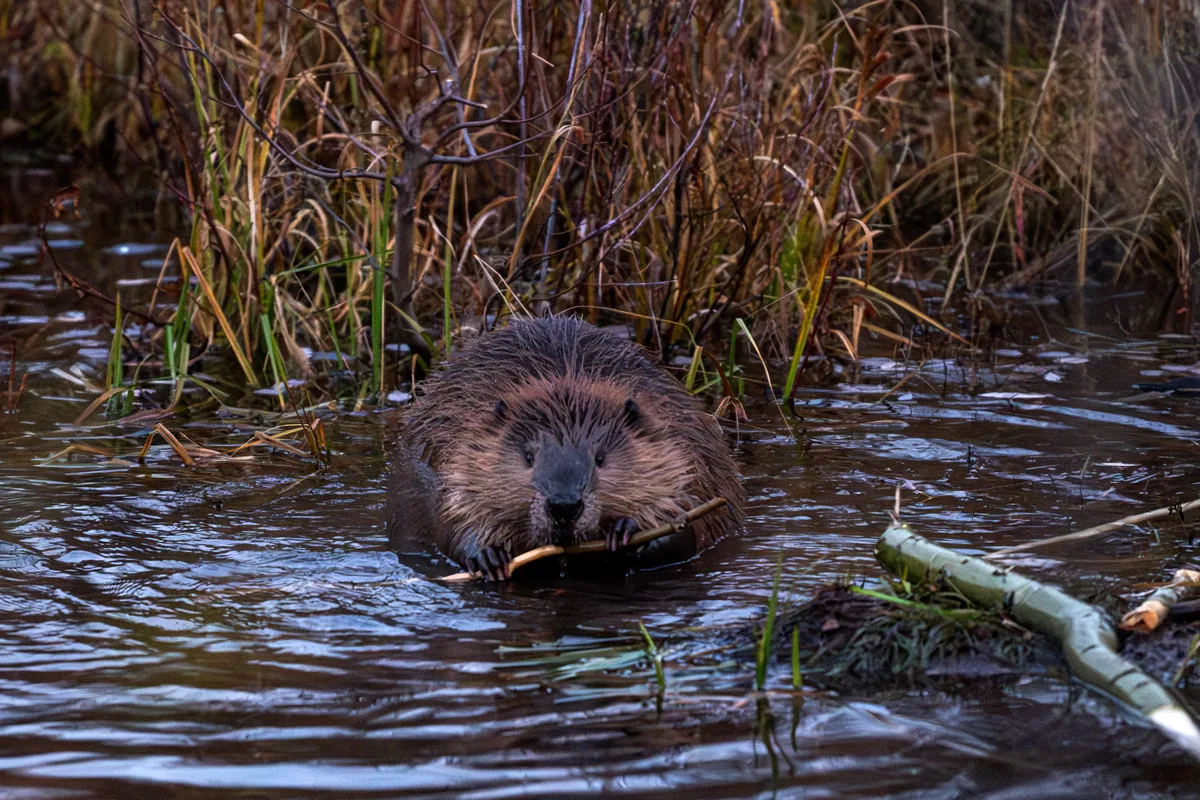
Yes, and that orange color is actually a feature, not a stain. Beaver incisors contain iron in the enamel, which gives them the distinctive rust color and makes them far stronger and more wear-resistant than ordinary teeth. Their teeth never stop growing and are self-sharpening through use, maintaining that chisel-like edge that lets them fell trees efficiently. If a beaver ever stopped chewing, its teeth would grow so long they’d prevent it from eating. 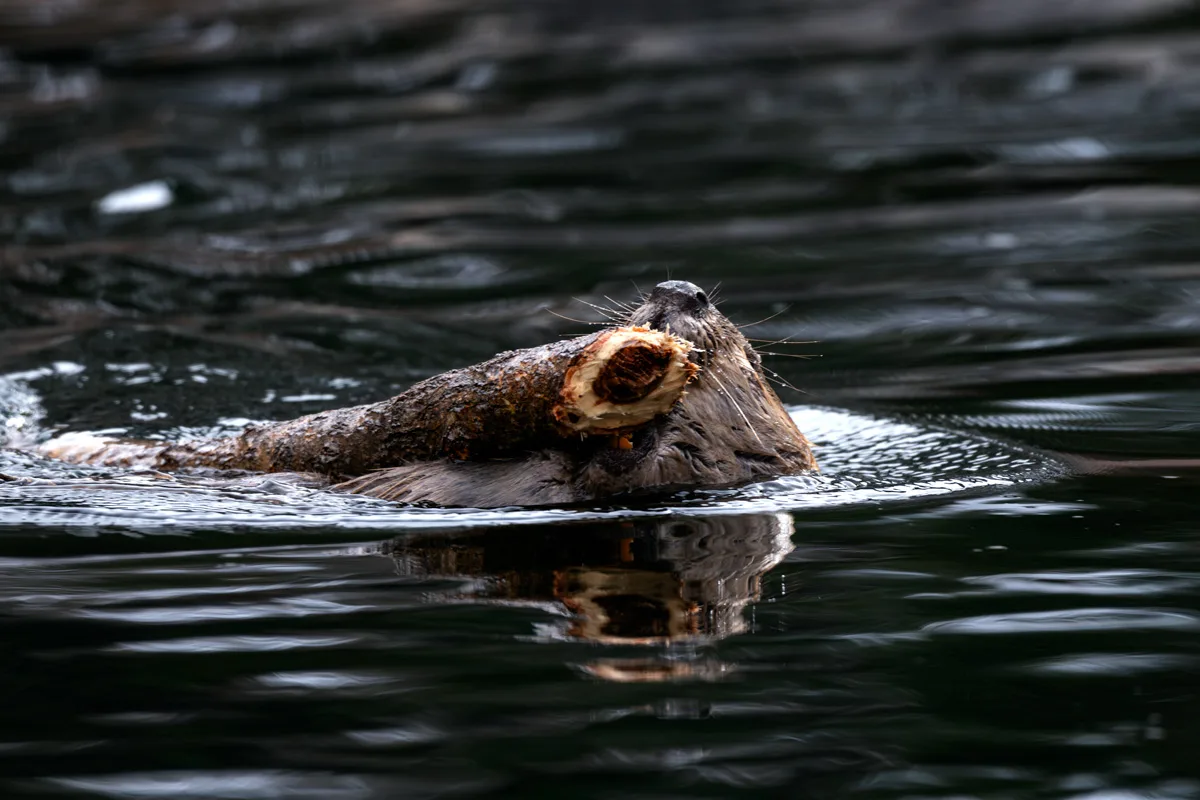
Adult beavers typically weigh 40 to 70 pounds and measure 3 to 4 feet long including the tail, making them the largest rodent in North America and the second-largest in the world. Their flat, paddle-shaped tail is a multi-tool: a rudder in the water, a prop on land, a fat-storage organ for winter, and the alarm instrument behind that famous tail slap. Webbed hind feet, dense waterproof fur, transparent inner eyelids, and nostrils and ears that seal shut underwater round out their aquatic adaptations.
Up to 15 minutes, though most dives last just a few. They can swim over half a mile underwater on a single breath, which helps explain why a beaver you were watching closely can seem to simply vanish.
A baby beaver is called a kit. Kits are born in the spring, usually in litters of two to four, and stay inside the lodge for their first month before venturing into the pond. They remain with the family colony for about two years before dispersing to establish their own territories, part of what makes beaver family life so visible and photograph-worthy around an active lodge.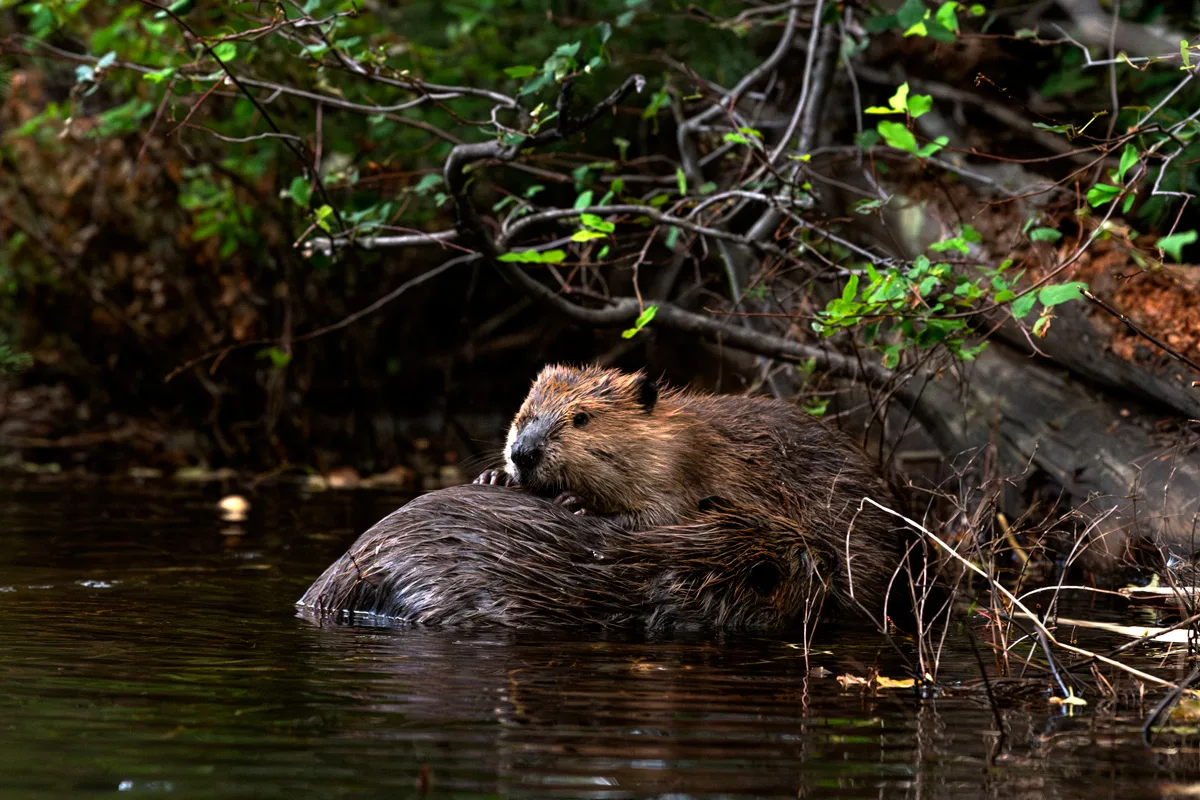
Beavers don’t hibernate. They spend the winter active but largely hidden, moving between their lodge and their underwater food cache beneath the ice, huddling together for warmth, and venturing out through open water only when they must. Their lodge interior stays remarkably stable, often 30 to 40 degrees warmer than the outside air thanks to body heat, mud insulation, and the thermal mass of the surrounding water.
Generally, no. Beavers are shy and will almost always flee or slap the water to warn you off rather than engage. That said, they are large wild animals, and a cornered or sick beaver can absolutely defend itself with those powerful teeth. Give them space, never block their access to water, and enjoy them from a respectful distance.
In the wild, beavers typically live 10 to 12 years, though some individuals reach 20. They live in family colonies that include the breeding pair, yearlings, and the newest kits.
Yes. Beavers are monogamous and generally mate for life, a trait that is surprisingly rare among mammals. A bonded pair stays together year-round, shares the work of building and repairing the lodge, and raises each litter of kits together. If a mate dies, the surviving beaver will usually find a new partner, but the original pair bond is real and lasting. It’s one of the reasons beaver family life feels so recognizable when you sit and watch them work.
Despite their size, beavers have plenty of natural predators, especially when they are young or caught on land away from water. Coyotes, wolves, bobcats, mountain lions, bears, and occasionally lynx all prey on beavers in the West. River otters and large birds of prey like great horned owls and eagles will take kits. Their best defense is the water, which is exactly why their lodges have underwater entrances and their ponds are kept deep enough to stay open even when ice forms above.
Beavers are not federally listed as threatened or endangered. Management varies by state. Some allow regulated trapping seasons, while others protect them more strictly, particularly where they’re being reintroduced as a natural tool for drought resilience and wildfire mitigation. Conservation-minded relocation programs have expanded significantly across the western United States in recent years.
Join Me in the Wild

There’s something about sitting quietly beside a beaver pond, feeding the mosquitoes and waiting, that reminds me why I do this. If you’d like to join me on a future workshop in the Grand Tetons, Colorado high country, or elsewhere, check out my upcoming photography workshops or subscribe below to my newsletter for trip reports, new image releases, and first access to workshop announcements. No spam, just stories and invitations to join me in the wild.
Prefer something bigger and louder? Read about a battle-scarred Shiras bull and his lady in Moose Romance: Photographing Colorado’s Wildside. Or swap willows for a frozen bird blind and read about my morning with the Sandhill Cranes at Bosque del Apache.


One Response